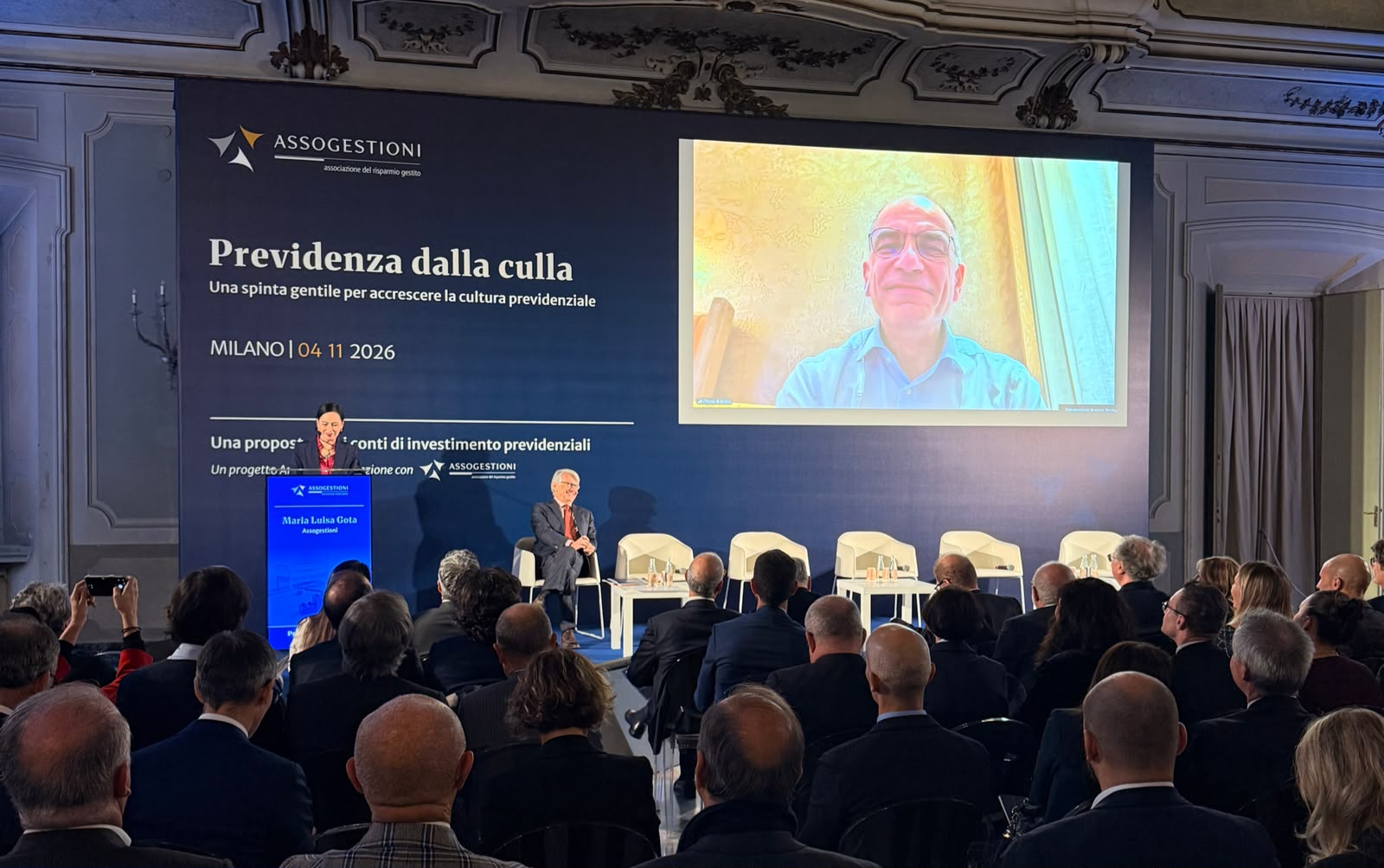
A public contribution of €10 per month for every newborn until the age of 18, allocated to supplementary pension provision from the outset. This is the central idea behind the Pension Investment Accounts (CIPs), a policy proposal put forward by Assogestioni and examined in detail in a technical study prepared by AREL, the Agency for Research and Legislation. The proposal was presented today at Palazzo Clerici in Milan, during the “Pension Savings from Birth” event organised by the Association.
The initiative aims to broaden access to supplementary pension provision while also offering a first practical experience of pension and financial education, based on the belief that familiarity with long-term saving should develop well before people enter the workforce. Being able to track an individual pension account over time, understand its performance and contribute to it voluntarily can help families gain greater awareness of financial planning, risk and diversification.
In a country marked by increasing longevity, declining birth rates and discontinuous career paths, starting to accumulate pension savings before entering the labour market means making the most of an irreplaceable resource: time. The potential benefit comes not simply from setting aside the contribution but from investing it through professional management, diversified portfolios and investment strategies suited to the time horizon.
Integrating CIPs into the existing supplementary pension system is a defining feature of the proposal. For Assogestioni, it is essential that the resources be channelled from the outset into established supplementary pension schemes supervised by COVIP, allowing pension funds to take full advantage of the long-term investment horizon. The objective is to establish a genuine pension savings pathway, rather than simply a savings account that could be converted into pension provision upon reaching adulthood.
Maria Luisa Gota, President of Assogestioni, stated:
“The Government has recognised a fundamental need: the financial security of younger generations must be built from birth. We welcome its decision to place this issue at the heart of discussions on the 2027 budget, recognising the value of broader access to pension provision.”
“While we are still awaiting further details, our position on the approach outlined so far is unequivocal: contributions must flow into supplementary pension schemes from the outset.”
“This choice would ensure that the measure is fully consistent with the course already set by the Government through the 2026 Budget Law, which introduced important measures to strengthen the second pillar. The new initiative could represent a further step in this direction, extending to younger generations the opportunity to build a more secure pension future and making the most of time as a fundamental resource. This is the real shift in perspective: making supplementary pension provision not merely a response to tomorrow’s needs, but a driver of inclusion and development for the country.”
Previdenza_dalla_culla_Gota_Letta_04.11.2026
The proposal marks a further stage in Assogestioni’s commitment to supplementary pension provision, building on the measures introduced by the 2026 Budget Law. For the Association, the Government’s focus on newborns in the 2027 budget is a very positive signal: encouraging broader participation in supplementary pension schemes also means strengthening institutional investors capable of mobilising patient capital for businesses and the real economy.
THE AREL STUDY: KEY FEATURES OF CIPS
Under the Assogestioni model, as set out in the technical study prepared by AREL, the Government would contribute €10 per month for every newborn until the age of 18, amounting to €2,160 per beneficiary upon reaching adulthood. Parents would be responsible for opening an individual account with a pension fund registered with COVIP, using the existing pension infrastructure.
Fabrizio Pagani, AREL, former Head of the Technical Secretariat at the Italian Ministry of Economy and Finance (MEF), stressed:
“What we are proposing is a high-impact mechanism requiring limited public resources. With long-term investments following a ‘life-cycle’ approach and thanks to compound interest, even modest initial amounts can generate capital of up to several hundred thousand euros by the end of a working life. In the study prepared together with Assogestioni, we presented a number of simulations. This is a virtuous combination of public resources and private savings: a small public contribution can set in motion a mechanism capable of delivering significant benefits for workers and the wider productive economy. Investing these resources in equities would also help finance businesses and the real economy.”
The public contribution would give every newborn the same starting point; the measure’s potential could increase if families chose to add to the account according to their means, including through small contributions from parents, grandparents and other relatives. To encourage these contributions, the proposal envisages an additional tax-deductibility allowance, to be defined in legislation. A direct relationship with the pension fund would make it possible to monitor the growth of the invested capital, turning voluntary participation into a practical experience of financial and pension education. The resources would be invested through life-cycle strategies, with risk exposure appropriate to the beneficiary’s age and gradually reduced over time; alternatively, they could be invested in the fund’s options with a higher equity allocation. The AREL technical paper, prepared in support of Assogestioni’s proposal and presented at the “Pension Savings from Birth” event in Milan, attended by representatives of AREL, public institutions, academia and the financial industry, is available at the following link: